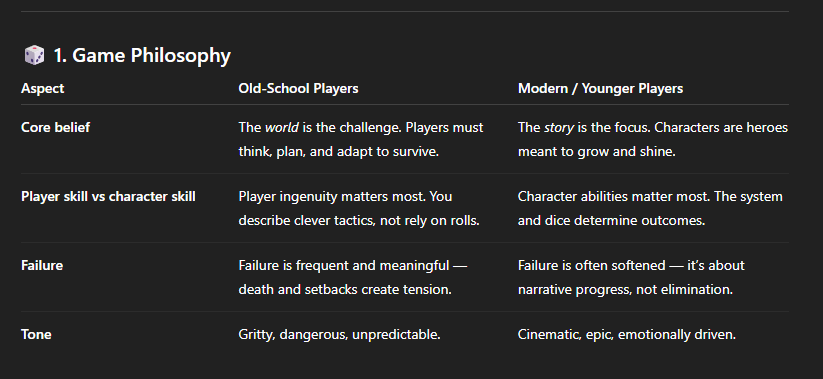
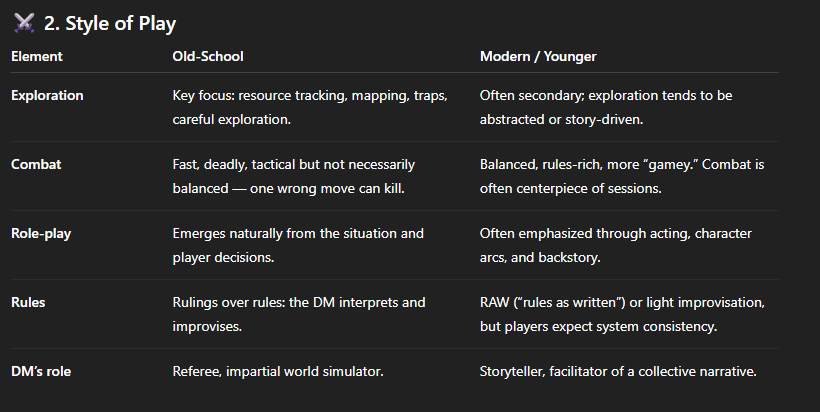
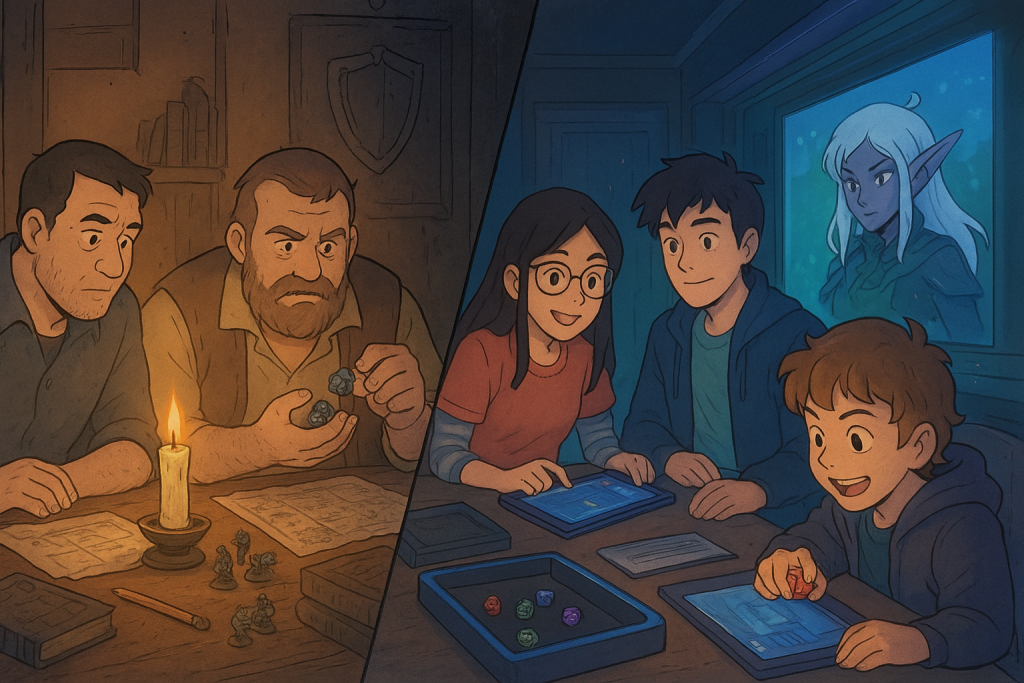
The contrast between old-school RPG players (often linked to OSR culture — “Old School Revival/Renaissance”) and modern younger players (especially 5e-era newcomers) goes much deeper than just rules: it reflects differences in philosophy, playstyle, and expectations.
What Each Group Looks For
🧙♂️ Old-School Players seek:
- Challenge & discovery. They want tension, risk, and genuine problem-solving.
- Player agency. Their decisions should really shape the world.
- Low power fantasy. Starting weak and earning power feels satisfying.
- Emergent stories. Memorable tales born from random rolls, accidents, and consequences.
- Minimal hand-holding. The game world doesn’t adapt to them, they adapt to it.
Example: “We found a weird statue in the dungeon. Let’s test what it does.”
→ It could turn to gold, it may curse you, it might summon demons — no safety net. That unpredictability is the fun.
🧝♀️ Modern / Younger Players seek:
- Story context and character identity. They want to express who their character is, emotionally and morally.
- Cinematic action. Big moments, cool abilities, and teamwork that feels heroic.
- Inclusivity & collaboration. Everyone contributes to a shared story; spotlight time is important.
- Rules as support for creativity. Mechanics exist to enable drama and personality, not limit it.
- Safety and comfort. Many prefer content boundaries and focus on shared enjoyment, not stress.
Example: “My tiefling warlock wants to confront her patron about betrayal — let’s role-play that scene!”
→ The session becomes about character emotion, not just danger or loot.
Common Misunderstandings
- Old-school players sometimes view modern ones as “soft” — too focused on comfort or power fantasy.
- Modern players sometimes view OSR types as “elitist” — too obsessed with difficulty and gatekeeping.
But both sides actually want immersion and meaning — they just find it through different paths: - OSR seeks authenticity through consequence.
- Modern play seeks meaning through narrative.
Can there be a middle ground (to play together?)
- Run 5e or other modern systems, but adopt OSR-style resource pressure or deadly combats.
- Or play old-school systems but emphasize character-driven storytelling.
More article about this topic available here:
- What’s the difference between Board Games, Miniature Games, and Role-playing Games?
- Dungeons & Dragons Culture Evolution
- Dungeons & Dragons 5th Edition is broken
Post available also on LinkedIn
Visit us on Social Media: